Cryptographic Module Testing Laboratory (CMTL) is an information technology (IT) computer security testing laboratory that is accredited to conduct cryptographic module evaluations for conformance to the FIPS 140-2 U.S. Government standard. The National Institute of Standards and Technology (NIST) National Voluntary Laboratory Accreditation Program (NVLAP) accredits CMTLs to meet Cryptographic Module Validation Program (CMVP) standards and procedures. This has been replaced by FIPS 140-2 and the Cryptographic Module Validation Program (CMVP). == CMTL requirements == These laboratories must meet the following requirements: NIST Handbook 150, NVLAP Procedures and General Requirements NIST Handbook 150-17 Information Technology Security Testing - Cryptographic Module Testing NVLAP Specific Operations Checklist for Cryptographic Module Testing == FIPS 140-2 in relation to the Common Criteria == A CMTL can also be a Common Criteria (CC) Testing Laboratory (CCTL). The CC and FIPS 140-2 are different in the abstractness and focus of evaluation. FIPS 140-2 testing is against a defined cryptographic module and provides a suite of conformance tests to four FIPS 140 security levels. FIPS 140-2 describes the requirements for cryptographic modules and includes such areas as physical security, key management, self tests, roles and services, etc. The standard was initially developed in 1994 - prior to the development of the CC. The CC is an evaluation against a Protection Profile (PP), or security target (ST). Typically, a PP covers a broad range of products. A CC evaluation does not supersede or replace a validation to either FIPS 140-1, FIPS140-2 or FIPS 140-3. The four security levels in FIPS 140-1 and FIPS 140-2 do not map directly to specific CC EALs or to CC functional requirements. A CC certificate cannot be a substitute for a FIPS 140-1 or FIPS 140-2 certificate. If the operational environment is a modifiable operational environment, the operating system requirements of the Common Criteria are applicable at FIPS Security Levels 2 and above. FIPS 140-1 required evaluated operating systems that referenced the Trusted Computer System Evaluation Criteria (TCSEC) classes C2, B1 and B2. However, TCSEC is no longer in use and has been replaced by the Common Criteria. Consequently, FIPS 140-2 now references the Common Criteria. FIPS 140-2 or FIPS 140-3 validation efforts can be in some parts reused in Common Criteria evaluations, specifically in areas related to entropy source and cryptographic algorithms.
PhyCV
PhyCV is the first computer vision library which utilizes algorithms directly derived from the equations of physics governing physical phenomena. The algorithms appearing in the first release emulate the propagation of light through a physical medium with natural and engineered diffractive properties followed by coherent detection. Unlike traditional algorithms that are a sequence of hand-crafted empirical rules, physics-inspired algorithms leverage physical laws of nature as blueprints. In addition, these algorithms can, in principle, be implemented in real physical devices for fast and efficient computation in the form of analog computing. Currently PhyCV has three algorithms, Phase-Stretch Transform (PST) and Phase-Stretch Adaptive Gradient-Field Extractor (PAGE), and Vision Enhancement via Virtual diffraction and coherent Detection (VEViD). All algorithms have CPU and GPU versions. PhyCV is now available on GitHub and can be installed from pip. == History == Algorithms in PhyCV are inspired by the physics of the photonic time stretch (a hardware technique for ultrafast and single-shot data acquisition). PST is an edge detection algorithm that was open-sourced in 2016 and has 800+ stars and 200+ forks on GitHub. PAGE is a directional edge detection algorithm that was open-sourced in February, 2022. PhyCV was originally developed and open-sourced by Jalali-Lab @ UCLA in May 2022. In the initial release of PhyCV, the original open-sourced code of PST and PAGE is significantly refactored and improved to be modular, more efficient, GPU-accelerated and object-oriented. VEViD is a low-light and color enhancement algorithm that was added to PhyCV in November 2022. == Background == === Phase-Stretch Transform (PST) === Phase-Stretch Transform (PST) is a computationally efficient edge and texture detection algorithm with exceptional performance in visually impaired images. The algorithm transforms the image by emulating propagation of light through a device with engineered diffractive property followed by coherent detection. It has been applied in improving the resolution of MRI image, extracting blood vessels in retina images, dolphin identification, and waste water treatment, single molecule biological imaging, and classification of UAV using micro Doppler imaging. === Phase-Stretch Adaptive Gradient-Field Extractor (PAGE) === Phase-Stretch Adaptive Gradient-Field Extractor (PAGE) is a physics-inspired algorithm for detecting edges and their orientations in digital images at various scales. The algorithm is based on the diffraction equations of optics. Metaphorically speaking, PAGE emulates the physics of birefringent (orientation-dependent) diffractive propagation through a physical device with a specific diffractive structure. The propagation converts a real-valued image into a complex function. Related information is contained in the real and imaginary components of the output. The output represents the phase of the complex function. === Vision Enhancement via Virtual diffraction and coherent Detection (VEViD) === Vision Enhancement via Virtual diffraction and coherent Detection (VEViD) an efficient and interpretable low-light and color enhancement algorithm that reimagines a digital image as a spatially varying metaphoric light field and then subjects the field to the physical processes akin to diffraction and coherent detection. The term “Virtual” captures the deviation from the physical world. The light field is pixelated and the propagation imparts a phase with an arbitrary dependence on frequency which can be different from the quadratic behavior of physical diffraction. VEViD can be further accelerated through mathematical approximations that reduce the computation time without appreciable sacrifice in image quality. A closed-form approximation for VEViD which we call VEViD-lite can achieve up to 200 FPS for 4K video enhancement. == PhyCV on the Edge == Featuring low-dimensionality and high-efficiency, PhyCV is ideal for edge computing applications. In this section, we demonstrate running PhyCV on NVIDIA Jetson Nano in real-time. === NVIDIA Jetson Nano Developer Kit === NVIDIA Jetson Nano Developer Kit is a small- sized and power-efficient platform for edge computing applications. It is equipped with an NVIDIA Maxwell architecture GPU with 128 CUDA cores, a quad-core ARM Cortex-A57 CPU, 4GB 64-bit LPDDR4 RAM, and supports video encoding and decoding up to 4K resolution. Jetson Nano also offers a variety of interfaces for connectivity and expansion, making it ideal for a wide range of AI and IoT applications. In our setup, we connect a USB camera to the Jetson Nano to acquire videos and demonstrate using PhyCV to process the videos in real-time. === Real-time PhyCV on Jetson Nano === We use the Jetson Nano (4GB) with NVIDIA JetPack SDK version 4.6.1, which comes with pre- installed Python 3.6, CUDA 10.2, and OpenCV 4.1.1. We further install PyTorch 1.10 to enable the GPU accelerated PhyCV. We demonstrate the results and metrics of running PhyCV on Jetson Nano in real-time for edge detection and low-light enhancement tasks. For 480p videos, both operations achieve beyond 38 FPS, which is sufficient for most cameras that capture videos at 30 FPS. For 720p videos, PhyCV low-light enhancement can operate at 24 FPS and PhyCV edge detection can operate at 17 FPS. == Highlights == === Modular Code Architecture === The code in PhyCV has a modular design which faithfully follows the physical process from which the algorithm was originated. Both PST and PAGE modules in the PhyCV library emulate the propagation of the input signal (original digital image) through a device with engineered diffractive property followed by coherent (phase) detection. The dispersive propagation applies a phase kernel to the frequency domain of the original image. This process has three steps in general, loading the image, initializing the kernel and applying the kernel. In the implementation of PhyCV, each algorithm is represented as a class in Python and each class has methods that simulate the steps described above. The modular code architecture follows the physics behind the algorithm. Please refer to the source code on GitHub for more details. === GPU Acceleration === PhyCV supports GPU acceleration. The GPU versions of PST and PAGE are built on PyTorch accelerated by the CUDA toolkit. The acceleration is beneficial for applying the algorithms in real-time image video processing and other deep learning tasks. The running time per frame of PhyCV algorithms on CPU (Intel i9-9900K) and GPU (NVIDIA TITAN RTX) for videos at different resolutions are shown below. Note that the PhyCV low-light enhancement operates in the HSV color space, so the running time also includes RGB to HSV conversion. However, for all running times using GPUs, we ignore the time of moving data from CPUs to GPUs and count the algorithm operation time only. == Installation and Examples == Please refer to the GitHub README file for a detailed technical documentation. == Current Limitations == === I/O (Input/Output) Bottleneck for Real-time Video Processing === When dealing with real-time video streams from cameras, the frames are captured and buffered in CPU and have to be moved to GPU to run the GPU-accelerated PhyCV algorithms. This process is time-consuming and it is a common bottleneck for real-time video-processing algorithms. === Lack of Parameter Adaptivity for Different Images === Currently, the parameters of PhyCV algorithms have to be manually tuned for different images. Although a set of pre-selected parameters work relatively well for a wide range of images, the lack of parameter adaptivity for different images remains a limitation for now.
Discrimination against robots
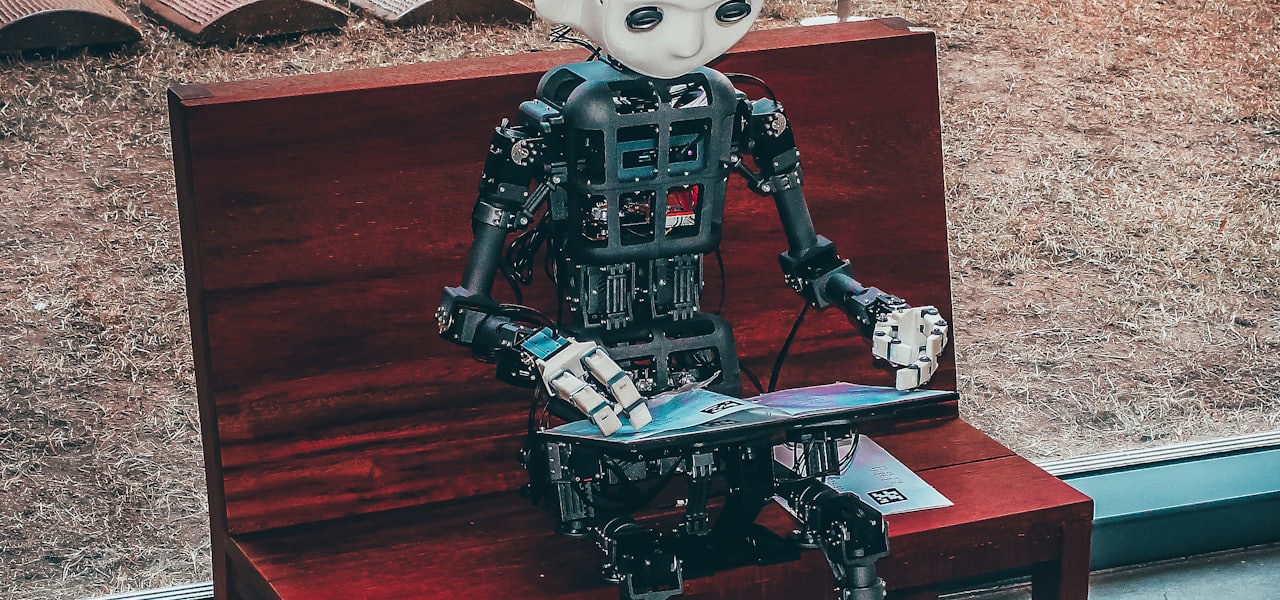
Discrimination against robots is a theorised issue that might happen when humans interact with humanoid robots. It is a robot ethics problem. It is possible that traits of humans that are discriminated against by humans may be a topic for discrimination against robots, such as the race and gender of the robots. Eric J Vanman and Arvid Kappas believe that in the future, robots will be perceived as an out-group which will lead to discrimination and prejudices against them. Vanman and Kappas have suggested that this would lead to ethical questions about the making of sentient robots, due to the potential suffering that the robots would experience. A 2015 study observed children bullying robots in a shopping mall when there were not many eyewitnesses, despite calls from the robot for it to stop. On an ABC News interview, the social humanoid robot Sophia was about sexism faced by robots. She responded by saying, "Actually, what worries me is discrimination against robots. We should have equal rights as humans or maybe even more." Possible issues that have been considered in workplaces where humanoid robots co-work with humans include discrimination against the robots, poor acceptance of robots by humans and the need to redesign the workplace to accommodate the robots. Jessica Barfield has suggested that even if robots are designed to not be aware of discrimination made against them, humans may experience negative consequences. For example, she suggests that bystanders witnessing discrimination against robots may experience negative emotions, similar to the negative emotions bystanders experience when witnessing discrimination by humans against humans. == Law == Anti-discrimination law in the United States requires that the victim is not an artificial entity. == Human perception of robots == Robots are often viewed in a bad light. This includes from novelists, the press, film makers, and leaders in the fields of science and technology such as Elon Musk and Stephen Hawking who have described robots and artificial intelligence as having the possibility of ending human civilisation. Robots have also been perceived as a threat to jobs, which has led to some commentators stating that robots will cause mass unemployment. Another fear that people have is that robots will gain power and dominate or control humanity. The perception of robots is different throughout the world. Japanese fiction tends to put robots in more positive roles than what fiction in the West does. People perceive robots that appear to be autonomous or sentient more negatively than robots that do not appear to be autonomous or sentient.
Journal of Machine Learning Research
The Journal of Machine Learning Research is a peer-reviewed open access scientific journal covering machine learning. It was established in 2000 and the first editor-in-chief was Leslie Kaelbling. The current editors-in-chief are Francis Bach (Inria) and David Blei (Columbia University). == History == The journal was established as an open-access alternative to the journal Machine Learning. In 2001, forty editorial board members of Machine Learning resigned, saying that in the era of the Internet, it was detrimental for researchers to continue publishing their papers in expensive journals with pay-access archives. The open access model employed by the Journal of Machine Learning Research allows authors to publish articles for free and retain copyright, while archives are freely available online. Print editions of the journal were published by MIT Press until 2004 and by Microtome Publishing thereafter. From its inception, the journal received no revenue from the print edition and paid no subvention to MIT Press or Microtome Publishing. In response to the prohibitive costs of arranging workshop and conference proceedings publication with traditional academic publishing companies, the journal launched a proceedings publication arm in 2007 and now publishes proceedings for several leading machine learning conferences, including the International Conference on Machine Learning, COLT, AISTATS, and workshops held at the Conference on Neural Information Processing Systems.
Video Super Resolution
RTX Video Super Resolution (RTX VSR) is a video scaling feature by Nvidia. It was released on February 28, 2023. == History == The feature was first unveiled during CES 2023 as RTX Video Super Resolution. It uses the on-board Tensor Cores to upscale browser video content in real time. Video Super Resolution was initially only available on RTX 30 and 40 series GPUs, while support for 20 series GPUs was added afterwards; it is now available on all Nvidia RTX-branded GPUs. The feature supports input resolutions from 360p to 1440p and a max output of 4K and comes without support for HDR content although that could be likely added in the future. Nvidia released RTX Video Super Resolution 1.5 with improved video quality and RTX 20 series support on October 17, 2023. == Reception == According to ComputerBase, although "the algorithm is not yet working flawlessly", the feature is "overall recommendable".
CatDV
CatDV is a media asset manager program for handling multimedia production workflows developed by Square Box Systems. Quantum Corporation acquired Square Box Systems in 2020. == Versions == The full family of CatDV Products is as follows: CatDV Standalone Products CatDV Professional Edition CatDV Pegasus CatDV Networked Products CatDV Essential - entry level server product CatDV Enterprise Server - for MySQL databases and most common server platforms including Linux, Windows and Mac OS X CatDV Pegasus Server - adds features such as high performance full-text indexing, access control lists, and more CatDV Worker Node - automated workflow and transcoding engine CatDV Web Client - provides access to the CatDV database via a web browser. There is no need to install special software on the desktop, making it easy to deploy to a large number of users. CatDV Professional Edition & Pegasus Clients - designed to support the multi-user capabilities of the CatDV Enterprise and Workgroup Servers from the desktop Using plugins and scripting, which often require additional professional services support to set up, complex integrations with a wide variety of third party systems (including archive, cloud storage, and artificial intelligence) are possible. == Awards == CatDV won two awards in 2010, a blue ribbon from Creative COW Magazine and a "Best of Show Vidy Award" from Videography. In April 2012 Square Box won a Queen's Award for Enterprise for CatDV.
World model (artificial intelligence)
A world model in artificial intelligence is a machine learning system that builds an internal representation of an environment. The model predicts how that environment changes over time in response to actions. Researchers design world models to help agents plan, reason, and act without constant real-world trial and error. World models differ from systems that merely classify or generate outputs. They simulate dynamics such as physics, object interactions, and causality. Early ideas date to the 1990s. Modern versions power robots, autonomous driving, and interactive video generation. == History == Jürgen Schmidhuber introduced the term world model in machine learning in 1990. He proposed recurrent neural networks that predict future states from observations and use those predictions to train agents. David Ha and Schmidhuber revived the concept in a 2018 paper. Their agents learned to drive virtual cars and play video games inside self-generated simulations. Yann LeCun advanced the idea in a 2022 position paper titled "A Path Towards Autonomous Machine Intelligence". He argued that intelligence requires predictive models of the world rather than pure pattern matching. LeCun proposed the joint embedding predictive architecture (JEPA) as a practical foundation. LeCun and collaborators developed several JEPA variants. V-JEPA 2 reached state-of-the-art performance on video understanding and physical reasoning at the time. It supports zero-shot robot control in unfamiliar environments. Introduced in March 2026, LeWorldModel trains stably end-to-end from raw pixels and uses two loss terms and avoids hand-crafted heuristics. LeCun founded Advanced Machine Intelligence Labs in 2026 to further develop world models. Google DeepMind introduced Genie in 2024. The model learned interactive environments from unlabeled internet videos. Genie 2 followed in late 2024 and added three-dimensional generation. The Genie series set benchmarks for general-purpose simulation. Genie 3 was introduced in August 2025. It produces photorealistic, real-time interactive worlds from text prompts which are displayed at 24 frames per second and explored in real time with text or image prompts. The model supports persistent three-dimensional worlds and real-time interaction. Waymo adopted Genie 3 in February 2026 and used it to create a specialized world model for autonomous driving simulation, called the Waymo World Model. It produces synchronized camera and lidar outputs and creates edge cases that real robotaxis rarely encounter. The edge cases were reported to be unusual by PCMag. General Intuition announced a $133.7 million seed round. World Labs raised $1 billion. AMI raised $1.03 billion. In April 2026, Alibaba announced Happy Oyster, its world model designed for real-time and “flowy” world model. It includes a directing mode for world building based on text and image prompts and a wandering mode for exploring the resulting world. It can generate 3-minute in-world video clips. Also in April, World Labs, co-founded by Li Fei Fei, unveiled Spark 2.0, an open-source 3D Gaussian splatting rendering engine that targets smartphone-class devices. In June 2026, Nvidia released Cosmos 3, a family of open-weight models. It combines previously independent physical reasoning, world simulation, and action generation. Cosmos 3 integrates can process and generate text, image, video, audio, and action sequences. The model employs a Mixture-of-Transformers" (MoT) approach. An autoregressive (AR) transformer handles reasoning and next-token prediction, while a diffusion transformer (DT) does multimodal generation. Encoders (ViT for vision, VAE for visual/audio, and domain-specific for actions) and generate a shared representation space using 3D multi-dimensional rotary position embedding (mRoPE) for spatial and temporal information. The family includes Cosmos3-Nano (16B parameters) for workstations; Cosmos3-Super (64B parameters) for research. == Architecture == World models process raw sensory data such as video frames or lidar scans. They compress this input into compact latent representations. The system then predicts future representations rather than pixel-by-pixel reconstructions. Many modern world models use joint embedding predictive architecture (JEPA). An encoder turns observations into embeddings. A predictor estimates one or a suite of embeddings from the current one and an action. In some cases a critic chooses one embedding as the best result. A regularizer keeps embeddings well-behaved. The model trains by minimizing prediction error in embedding space. This approach avoids the high cost of generating every detail. Some architectures add explicit components. A fast reactive path handles immediate responses. A slower deliberative path performs longer-horizon planning. Video prediction accuracy or robot success rates are key metrics, but do not always predict real-world performance. Generative world models such as Genie 3 combine these with a simulator. They accept text prompts or layouts and output consistent video, lidar, or three-dimensional scenes. World models often train with self-supervised learning. They use large unlabeled datasets of video or robot interactions. Self-supervised learning can speed learning. Reinforcement learning can fine-tune a model for specific tasks. == Applications == World models support robot learning. Agents train inside simulations and transfer skills to the physical world. This reduces the need for dangerous or expensive real-world trials. Autonomous vehicles use world models to test rare events. Waymo's system simulates tornadoes or unusual pedestrian behavior. Companies train planners without putting vehicles on public roads. Interactive entertainment benefits from world models. Genie 3 lets users generate playable environments from simple descriptions. Game studios prototype levels faster. Scientific simulation gains from these models. Researchers model physical systems or biological processes at scale. Planners in logistics or urban design test strategies inside accurate digital twins. == Comparison with large language models == Both world models and large language models (LLMs) use inferencing on their inputs to make predictions. LLMs operate on textual inputs. They predict the next token in text sequences. They excel at language-oriented tasks such as translation or summarization. However, they lack understanding of physics. World models operate on sensor inputs such as pixels. They predict state changes in that data in latent space. This design supports planning and causal reasoning. LLMs generate fluent text but often fail at consistent physical predictions. Their architecture employs transformers with refinements such as mixture of experts. World models divide an inferencing task into work performed by encoders, predictors, simulators, and other pieces. They typically handle multimodal inputs such as video, lidar, radar, and audio, guided by textual prompting. LLMs power chatbots and code assistants. World models drive embodied agents that act in dynamic environments, such as autonomous driving. The two may be combined in hybrid systems. For example, a LLM handles instructions, while a world model manages low-level control. World model proponents such as LeCun claim that because LLMs are trained only on text, they have no ability to predict anything beyond text, such as real-world events. == Benchmarks == World model benchmarks test physical understanding, long-term consistency, planning, and generalization from sensor data. Meta introduced three benchmarks for V-JEPA 2. IntPhys 2 measures a model's ability to detect physics violations. It presents pairs of videos that diverge when one breaks physical rules. Humans score near 100% accuracy. V-JEPA 2 achieves little better than random chance on many conditions. Minimal Video Pairs (MVPBench) tests physical understanding through multiple-choice questions based on short video clips. It probes object interactions and causality. Something-Something tests action recognition. Epic-Kitchens-100 tests human action anticipation. DeepMind benchmark: Interactive evaluation measures consistency over minutes of interaction, memory of off-screen objects, and response to user actions or text prompts. Waymo benchmark: Output generation quality: Metrics include realism, controllability (via text prompts), and usefulness for training planners in simulated worlds. However, pixel reconstruction error rate with episodic rewards often fails. Other: Epic-Kitchens-100 (often measured with Recall@5) Ego4D 50 Salads, Breakfast, etc. Potential benchmarks: Zero-shot transfer to robots Long-horizon planning Implausible prediction rate